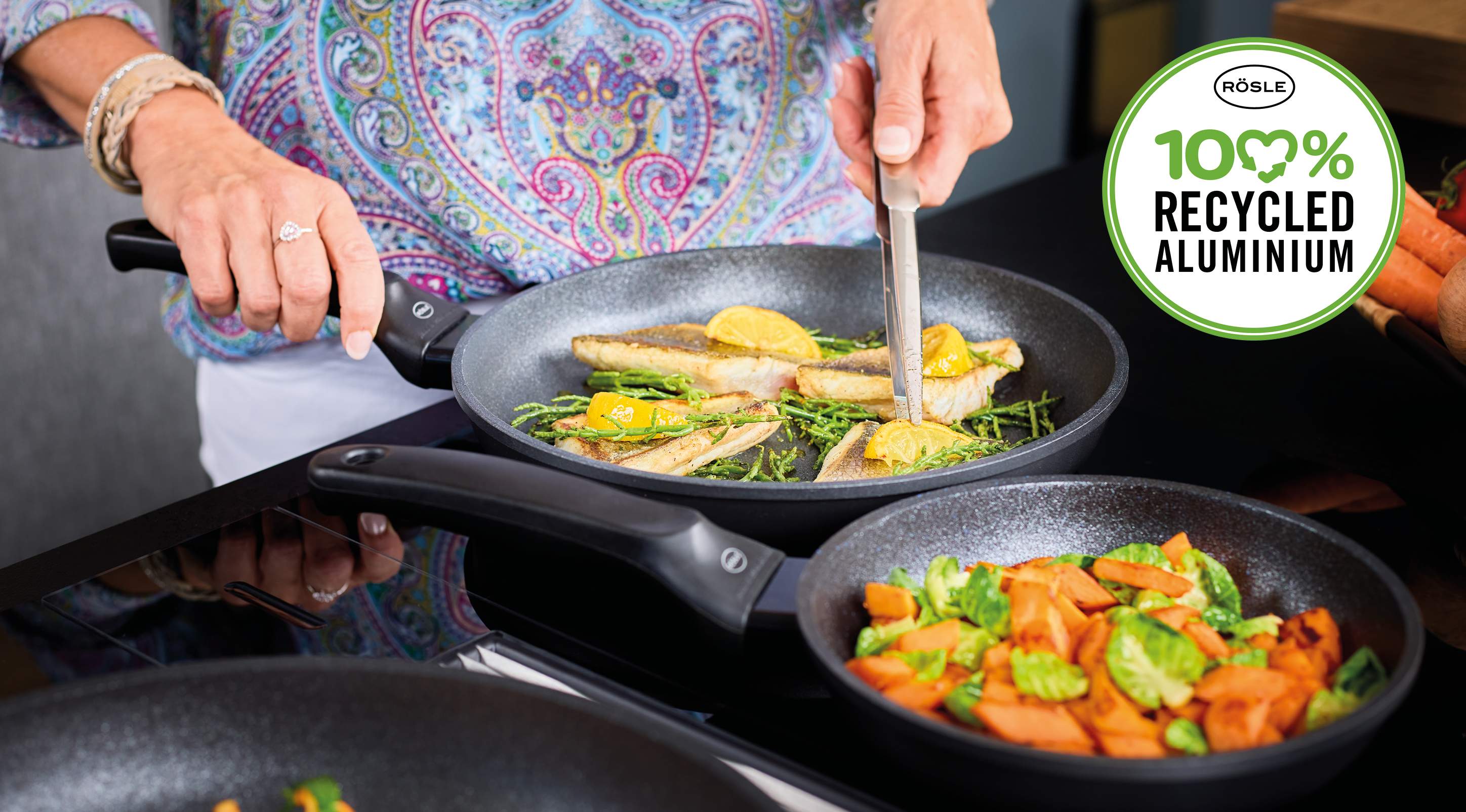
.We also want to implement sustainability in our quality products. That's why we use 100 percent recycled aluminium for our aluminium pans.
HENNING KLEMPP
Managing Director RÖSLE GROUP
How the RÖSLE GROUP from Marktoberdorf implements sustainability
The RÖSLE GROUP from Marktoberdorf is celebrating its 135th anniversary this year - it was founded in 1888 in Marktoberdorf as a tinsmith's workshop. The company, which has always been family-owned and based in Marktoberdorf, generates an annual turnover of over 100 million euros with almost 250 employees. The RÖSLE brand has earned an excellent reputation far beyond the borders of Germany, not only in the field of high-quality kitchen tools and barbecues. The GRÖMO brand - also based in Marktoberdorf - is also part of the RÖSLE GROUP. GRÖMO develops, produces and sells roof drainage accessories and is known for its high-quality, long-lasting products.
Today, the term "sustainability" is interpreted to mean that only that which can be regrown to the same extent
is consumed. The core of this statement, namely to operate in a future-oriented and long-term manner, was already a goal of the RÖSLE company in the past: to fulfil its responsibility towards its sales partners, customers and, of course, its employees.
An enormously important aspect of the responsible philosophy is the products that are manufactured. "We also want to implement sustainability in our quality products," says Managing Director Henning Klempp, describing the strategy. "That's why we use 100% recycled aluminium for our aluminium pans." This is a very effective step towards avoiding greenhouse gases. If recycled aluminium is used, as is the case at RÖSLE, around 95 percent of energy is saved, and with it a corresponding amount of CO2.
The GRÖMO brand also relies consistently on recycling. The sockets and elbows for roof drainage are made from copper, zinc and aluminium. These raw materials are all recyclable.
Durability and quality
Sustainability also results from the quality of a product. This not only ensures satisfied customers, but also that they enjoy their product for many years to come. Cheap goods may cost less to buy initially, but their life cycle is shorter and they have to be replaced much more quickly. This not only costs money, but also consumes more raw materials and generates unnecessary waste.
The RÖSLE GROUP also avoids unnecessary paper consumption. Some printed catalogues have already been abolished. The aim is to achieve 100 per cent digital and paper-free work at the RÖSLE GROUP. RÖSLE also offers its sales partners the option of sending the goods directly to the end customer. This means that the parcel only has to travel once and the intermediary saves its own warehouse capacity and therefore also
resources.
This is made possible by a new ERP system and the new logistics centre currently under construction, which is being incorporated into comprehensive process-optimised planning of workflows. This not only saves time and money, but also energy. What's more, these processes enable us to respond even better to customer requests. Incidentally, the RÖSLE Outlet Marktoberdorf is also being rebuilt and will have the necessary space for the kitchen and BBQ areas over two floors. The cookery and barbecue school will be located on the top floor, another first in the company's history. The new building is of course characterised by sustainability. The centre is heated and cooled using a modern heat pump. The electricity for this comes from the PV system, which is also being installed on the new logistics centre. The RÖSLE GROUP has a lot of experience when it comes to photovoltaics. Since the construction of the GRÖMO building in Röntgenring, sunlight has been converted into electricity.